


This section provides information on workforce planning, job planning, staffing and resource implications for proposed service developments and how skill-mix, resources and demographics influence this. It also includes the role of RCSLT in workforce planning and supporting the profession.
You may also want to review our page on service planning
Last updated: February 2026

 Download as PDF
- Introduction
- Workforce planning
- The role of the RCSLT
- Staffing and resourcing
- SLT job profiles
- Job planning
- Estimating staffing levels
- Changing skill mix
- Resources
- Contributors
Introduction
An effective and efficient high-quality service requires the right people, with the right skills, in the right place, at the right time and with the right support and resources.
This section provides information on workforce planning, job planning, staffing and resource implications for proposed service developments and how skill-mix, resources and demographics influence this. It also includes the role of RCSLT in workforce planning and supporting the profession.
This information aims to support heads of service in planning and costing changes to their skill-mix for service delivery redesign.
Workforce planning
Workforce planning is the process of ensuring that we have SLTs in the right numbers, with the right skills and right values and behaviours needed to provide high-quality care.
Workforce planning is a multifaceted issue which links to a range of topics
| Needs assessment |
|
| Policy and legislation |
|
| Decision makers and budget holders |
|
| Interventions that achieve outcomes |
|
| Workforce practices and skills mix |
|
| Education and training |
|
At the heart of workforce planning is a desire to meet the needs of service users (both now and in the future) and provide patient-centred and personalised care.
Meeting the needs of service users also relies upon:
- the evidence base (gathering research on ‘what works’ and using this to inform interventions)
- outcomes measures (collecting data which demonstrates the impact of local services).
As a service manager, understanding the context of workforce planning can:
- assist you in taking a holistic view in how you develop and promote your service
- enable you to successfully engage with decision makers and commissioners when responding to service restructures or cuts
- help you understand how your service contributes to workforce planning as a whole.
Delivering quality services contains a comprehensive range of guidance and resources to support you in planning your service.
The role of the RCSLT
Part of RCSLT’s role is to provide system wide leadership and oversight of speech and language therapy workforce planning, education and training. We aim to understand trends in relation to workforce issues, such as:
- how many SLTs work in different parts of the UK (and how and why that might be changing)
- the balance between supply and demand for SLTs (do we have enough SLTs to meet need)
- proposed changes to service structures and priorities, i.e. introduction of apprenticeships, advance practitioner roles, cuts to services/SLT posts (i.e. NHS band 8 posts) and their consequences
- effectiveness of different service delivery models.
RCSLT also works to protect the interests of those with speech, language and communication needs and those with eating, drinking and swallowing needs. We promote the work and role which the speech and language therapy profession plays in our society to governments and parliaments across the UK. We work with decision-makers and our members to help improve policy across the UK, England, Wales, Scotland and Northern Ireland, and internationally.
We use this information to:
- offer insight into key issues affecting people with communication and swallowing needs
- promote the voice of speech and language therapists at a national and local level
- inform NHS workforce planners
- tailor and improve our support to members
- influence policy makers, research funders and researchers
- help members to respond to proposed changes in service (i.e. service structures, leadership, cuts).
Staffing and resourcing
It is in service users’ best interests for managers/professional leads to proactively identify the information their audience groups need to know. This ensures services have the right people, with the right skills, in the right place, at the right time and with the right support and resources.
Budget holders and decision makers, for example, may be focused only on face-to-face contact figures. It is essential that they are provided with details of direct and indirect activities, to help them understand the diverse range of functions including preventative work, upskilling the wider work force that speech and language therapists carry out, often within the context of a multidisciplinary or integrated care pathway.
Staffing and skill mix
Considering skill mix is an integral part of assessing staffing levels required for effective service provision. A review of skill mix will reflect on the number of staff working at differing levels in each service area, and how these integrate to support each other.
One aim of skill mix is to free staff to use their skills and knowledge to maximum effect. Skill mix can have a positive effect on both staff recruitment, retention and efficiency.
In relation to a given context, an appropriate skill mix may reflect:
- a range of professionals across the care system
- different grades, competencies and specialties of SLTs
- bilingual therapists and or support workers
- support practitioners
- technicians
- multi skilled practitioners
- administrative and clerical support.
Managers and commissioners should be aware of the range of influences on local skill mix requirements.
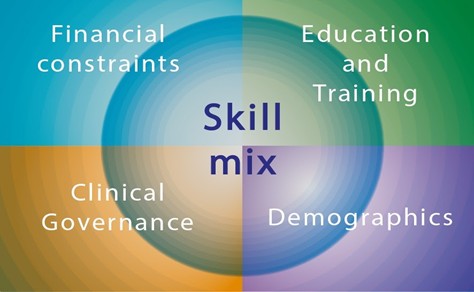
- Financial constraints: it is helpful to gain some indication from your organisation and commissioners of any financial constraints applying to service development bids.
- Clinical governance:a prime consideration should be the need to provide safe and effective services to individuals. This includes having staff who are competent in the required tasks and who are adequately supported by supervision. There must be sufficient senior staff with designated time to supervise and support less experienced therapists and support practitioners or other partners who assist in delivery of clinical care. For further reading, please see RCSLT advice pages on delegation.
- Education and training: the types and levels of knowledge, skill and expertise required to meet the needs of the target group. This may include the need for highly specialised expertise. See our clinical guidance for information relating to specific client groups and our CPD and lifelong learning section for information about continuing professional development.
- Demographics: including geography, population, age groups, health needs, socio-economic profile, deprivation and ethnic diversity.
Example 1. Diversity: the workforce should reflect the ethnic and socio-economic diversity of the local community. The workforce must include access to interpreting / translating services and/or bilingual practitioners.
Example 2. Geography: services within a very rural context are likely to require staff to have high levels of expertise across a range of functions; with less access to very highly specialist services. Services within an urban context are likely to be better placed to have staff with very high degrees of specialism within their skill mix.
SLT job profiles
The Agenda for Change clinical profiles (published in 2006 and rebranded in November 2023) are the most current source of information on the skills required and tasks performed at each level by SLTs working in the UK. The profiles, along with the NHS Job Evaluation handbook, are hosted on the NHS Employers website. While these have been developed for the NHS, they can be used to inform the development of job descriptions and person specifications for other employment sectors.
Job planning
What is a job plan?
A job plan is a prospective, professional agreement describing each employee’s duties, responsibilities, accountabilities and objectives. A job plan will outline how an individual SLT can expect their working time to be used according to specific categories listed below over the course of a year.
- Direct clinical care (DCC) – this includes all clinical and clinically related activities e.g. carrying out assessments, delivering interventions, administrative tasks, attending multidisciplinary team meetings, ward rounds, clinical reviews.
- Supporting professional activities (SPA) e.g. clinical management, CPD, audit, research, appraisal, teaching, training.
- Any additional duties or responsibilities (ANR) within the organisation e.g. chair of a committee, mental health first aider, speak up guardian.
- External Duties (ED) e.g. external roles which are externally funded for example guest lecturer at a university, or research.
In addition, a job plan should outline the support the employer will provide to enable the employee to achieve their objectives. This may include a list of supporting resources or a plan to overcome any organisational barriers to meeting their objectives.
Why is job planning important?
Job planning can be beneficial for speech and language therapists.
A job plan should clearly articulate the activities that are within scope for a given role, providing clarity and transparency. The process of developing a job plan should provide an opportunity for discussions about an individual’s career development, goals and aspirations.
Job planning is valuable for those managing and leading services. Job planning can assist with allocating resources to meet service demand in a way that is safe and delivers positive outcomes. It can help with demonstrating productivity, workforce planning and service redesign. Job planning can have a positive impact on staff morale, aiding retention.
If you work in the NHS in England, it is a requirement to have a job plan. Job plans are a valuable tool for speech and language therapists working in other employment sectors and other areas of the UK.
What is an e-job plan?
An e-job plan is a job plan that has been digitised. Some employers use dedicated e-job planning software. You can find an example here: Job Planning
What tools are available to support with job planning?
Estimating staffing levels
Estimating numbers of speech and language therapy staff required at each level of skill within a given model of service provision, is essential to achieving an effective and efficient service. There has been much debate around assessing required staffing levels on the basis of nationally agreed notional caseloads. Guidance from workforce planners’ states that notional caseloads on their own are insufficient for calculating staffing levels. This is because of the number of other variables that impact on working practice and what constitutes a manageable practitioner caseload.
Variables include:
- chosen model of service provision
- local geography and accessibility
- range and number of local co-providers
- risk management issues
- safeguarding issues for vulnerable children and adults
- grading and skills of practitioner
- ratio of clinical to non-clinical practitioner time available.
For example, the competence, knowledge and skills expected of therapists varies according to grading. This will affect the clinical input expected and in turn may affect the numbers of people that they are able to see.
A senior therapist, for example, will be required to see people with complex issues who may require larger amounts of time than people with more straightforward issues. The senior SLT may see fewer people in the clinical time available than a practitioner on a lower banding. In this scenario the clinical time itself may be less as they may have a range of other responsibilities in relation to research and development, providing practice-based learning opportunities and supervising other practitioners.
However, a notional caseload may be arrived at locally in relation to a given client group by taking all the variables into account.
Elements influencing estimation of notational caseloads
Notational caseloads are dependant on a number of factors, which need to be taken into consideration while making estimates:
- practitioner grading and skills
- role expectations and job plans
- clinical time available
- skill mix of SLTs and wider staff group
- resources including technology available
- nature of care group needs
- model of service
- complexity of individual needs
- urban/rural setting.
In some speciality areas national safer staffing guidance has been produced, see the resources section of this page for more details.
Changing skill mix
Reviewing skill mix in healthcare is crucial because it ensures the right balance of healthcare professionals with different skill levels are available to deliver safe, effective, and patient-centred care, optimising quality while managing costs by utilising each staff member’s abilities appropriately. Conversely, a poor skill mix can lead to compromised patient outcomes, increased risks, and inefficient use of resources.
Planning and costing for skill mix and evaluating how your service is delivered, and networks with others, can enhance quality and reduce cost. You may be able to use your human resources differently to achieve similar results.
One way of doing this is to look at the mix of skills and experience in your team and the wider workforce in which it operates.
- What skills are available in your team? For example, are you staff skilled in using digital/technology available or in delivering training to others?
- What skills are available within the wider workforce? How can you enhance these through training and effectively utilise them to support your service?
- How are you utilising support workers (clinical and non-clinical e.g. admin) within your team and in the wider workforce?
To effectively review skill mix, you need to:
- analyse your current skill mix and service provision. Find out about methods for assessing current skill mix and establishment in the RCSLT’s Service planning and responding to proposed changes information
- draw comparisons with how services are provided to similar service user groups across the UK, considering their outcomes and costs. Clinical excellence networks (CENs) may prove a useful resource of information
- audit your referral rate and different patient groups and their presenting needs
- consider service provision in terms of access and location of service-providers and users
- audit and review outcomes for the current service, in relation to cost.
It is also important to highlight your service’s involvement in developing the skills of others who work with your client group, but who don’t work in your team including those who work for a different employer/organisation (e.g. NHS and independent SLTs working together). Nurses and learning support assistants, for example, commonly work with speech and language therapy teams, ensuring care is delivered effectively in a mix of settings to the greatest effect. You should identify how your service delivers value to patients and commissioners through this model of service, where people who are employed outside your team are enabled to support service users’ needs so enabling better outcomes.
Highlight any extended roles for speech and language therapists, and how these may reduce costs by improving outcomes. For example, fees, critical care, counselling, training of others. See:
When writing a business case for commissioners, the cost efficiencies of non- contact time must be made clear: costs of training as should any additional equipment, accommodation or admin support.
For more detailed information see Preparation for your business case section within the Service planning and responding to proposed changes pages.
Resources
RCSLT resources
- Neonatal: Speech and language therapy staffing recommendations for neonatal units
- Critical Care: Position statement: speech and language therapists working in adult and paediatric critical care units
- Telehealth: Telehealth guidance
- Schools: Caseload vs workload
RCSLT topics
- Service planning and responding to proposed changes (link to be added)
- Quality services and quality improvement processes (link to be added)
- Delivering quality services
- Clinical guidance
- Research
- Leadership resources
- CPD and life-long learning
- Evolving roles
- Careers in advanced practice
External resources
- The Faculty of Intensive Care Medicine Guidelines for the provision of intensive Care services
- Royal College of Physicians National Clinical Guideline for Stroke
- Skills for Health Workforce development tool
- Skills for Health Six Step Methodology to Integrated Workforce Planning®
- NHS England Ten Year Plan
- NHS England Safe staffing improvement resources for specific settings
- NHS Education for Scotland Health workforce planning and projections
- Charlotte Colesby, Job Planning
- Equity for All: Children’s Speech and Language Therapy services in Scotland (2022)
- NHS Education for Scotland (NES) – offers education, training, workforce development
- Health and Care Staffing Act (2019) Scotland – provides a statutory basis for the provision of appropriate staffing in health and care services, enabling safe and high-quality care and improved outcomes for service users.
- Health Education and Improvement Wales (HEIW) Workforce planning
- Academi Wales– Learning and development for leaders and managers working throughout Wales
- Department of Health (Northern Ireland) Workforce planning
- National Quality Board – Supporting NHS providers to deliver the right staff, with the right skills, in the right place at the right time
Contributors
Lead Author
- Maria Luscombe FRSCLT
Supporting Authors
- Jo Bradburn, Deputy Director of Allied Health Professions and Speech and Language Therapist
- Natacha Capener, Lecturer and Speech and Language Therapist
- Nicola Holmes, Chair of ASLTIP
- Wing yee Lam, Practice Development Speech and Language Therapist
- James Martin, Highly Specialist Speech and Language Therapist (Head & Neck)
- Katie Masters, Specialist Speech and Language Therapist
- Claire Matheson, Service Lead Adult Learning Disability
- Rosalind Gray Rogers, Programme Director for Speech and Language Therapy
- Jo Taylor, Speech and Language Therapist
- Paula Walker, Highly Specialist Speech and Language Therapist


