


The RCSLT Professional Development Framework (PDF) is a UK wide resource that has been co-created by and for speech and language therapists.
Professional Development Framework
The RCSLT Professional Development Framework provides a structured format to support individuals, managers, and organisations to identify the learning and professional development needs of speech and language therapy practitioners across the whole career span, in all sectors, and all UK countries.
The framework is designed to:
- be used flexibly to guide practitioners, teams, and organisations
- be used as a whole or in parts, returning to it at different times within your career
- identify existing knowledge and skills with individuals and teams
- inspire future learning for knowledge and skills development
- provide a structure to support the CPD diary (where appropriate)
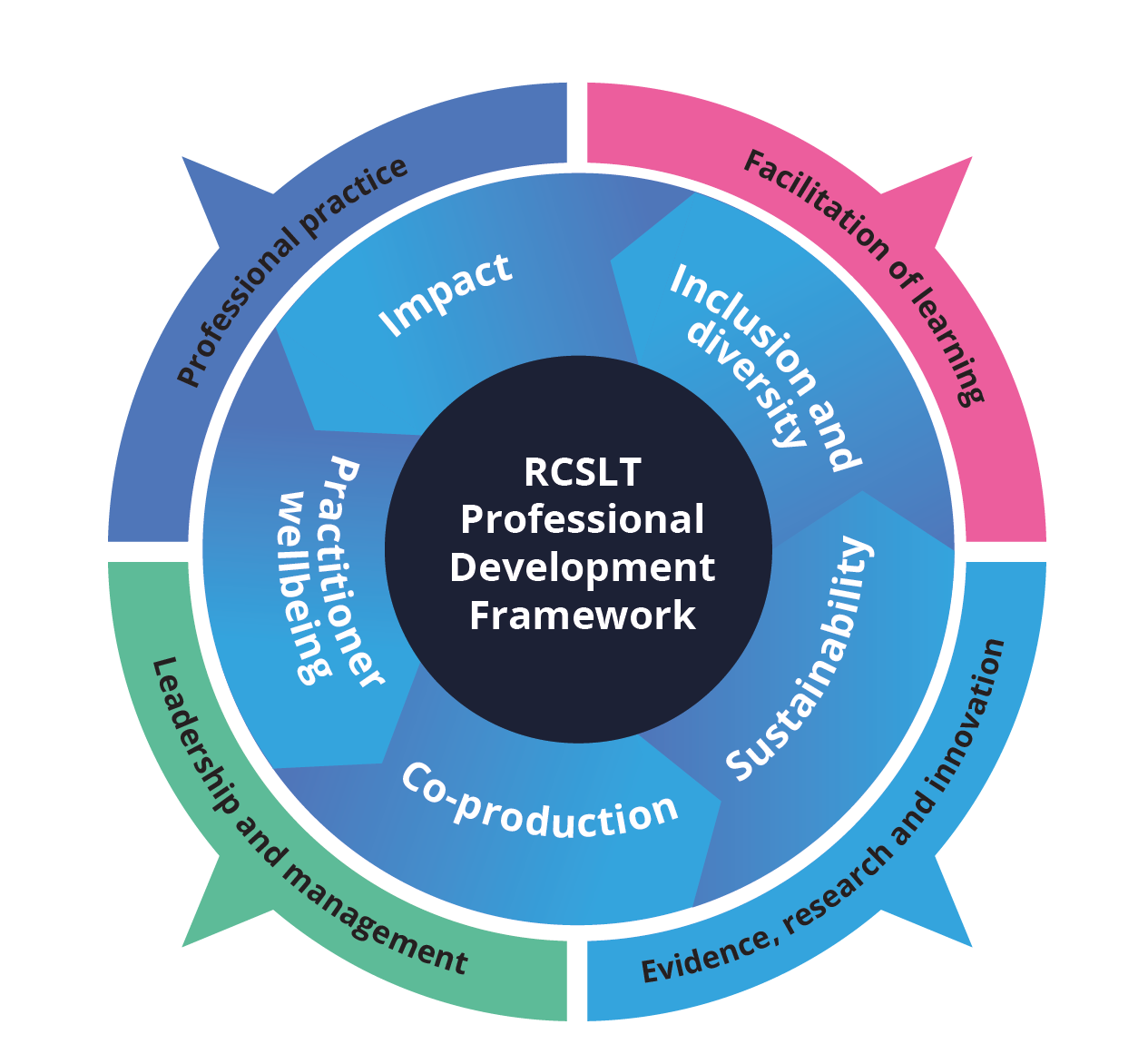
The framework has been developed around:
- five core components (practitioner wellbeing, impact, inclusion and diversity, sustainability, co-production) and
- four pillars of practice (professional practice; facilitation of learning; evidence, research and innovation; and leadership and management).
Each pillar has several subthemes with detailed topics to enable you to evaluate your current professional development level, to identify your existing knowledge and skills and your future learning and development areas.
The framework provides a profession-specific resource to support career conversations, including at any transition point e.g. newly qualified practitioner. It also helps you think about the transferable knowledge and skills you bring from previous and current paid roles, voluntary roles, and life experiences, including as an experienced therapist as you advance your career.
How to use the framework
The Professional Development Framework is a profession-specific resource and has been designed with speech and language therapists in mind, and as such the primary audience is SLTs. However, it is also of interest to operational and strategic managers and leaders, as well as managers in multi-disciplinary teams from different professions. It is also of interest to service users, students, support workers and those considering speech and language therapy as a career.
There is no right or wrong way to use the framework – it has been designed to be flexible and help to meet your needs irrespective of career stage or setting. The framework can be used in the processes that support professional development including but not limited to:
- Appraisals / individual performance reviews
- Supervision (one-to-one, group and peer), mentoring or career coaching
- Preceptorship for newly qualified practitioners
- Return to practice
- Personal statements for job applications including promotions within and beyond the profession
- Articulating advanced and expert level (transferable) knowledge and skills for career progression that transcends professional boundaries e.g. at the senior management and executive level
- Preparation for the HCPC audit
- Moving sectors e.g. into a diverse role, academia, or a leadership role
- Developing a portfolio career
- Active retirement planning (Sainty, 2018)
Getting the most out of the framework
Here’s some tips to help you get the most out of the framework:
- Each of the core components and pillars of practice do not need equal weighting and attention. You may find you want to shine a light on aspects at different points in your career e.g. a move into education will see a greater focus on facilitation of learning, or a leadership secondment with a national arm’s length body will see a greater focus on leadership and management.
- You can work through the framework on your own or you may want to map yourself into it with a trusted colleague or critical friend. As with most frameworks, it is the conversations they start that can be the most illuminating and support deeper reflection and learning on your own professional development.
- It can be used as a tool within supervision but, if your supervisor is also your line manager, this dynamic may affect the nature of the discussion and is one to notice.
- Use the detailed topics as starting points to identify courses and other learning opportunities e.g. secondments to support your career progression.
- Return to the framework at different stages of your career to review your progression and identify new topics for learning and development.
The four pillars of practice
The four pillars of practice are overall themes for the framework, allowing you to focus on different aspects of your SLT career as and when you want to.
Each of the Professional Development Framework’s four pillars of practice has several subthemes, with aligned detailed topics. You can use the subthemes and the detailed topics as part of your self-evaluation. The five core components have been woven through the four pillars of practice, subthemes and detailed topics to embed them across all areas of learning and development.
The four pillars and their subthemes are listed below.
Professional practice
- Communication
- Eating, drinking and swallowing
- Safe, effective, high-quality practice
- Ethical and values-based practice
- Autonomy and accountability
Facilitation of learning
- Supervision and coaching
- Teaching and mentoring
- Creating learning resources, environments and opportunities
- Self-awareness and development
- Lifelong formal and informal learning
Leadership and management
- Effective teamwork
- Promote the profession
- Lead change
- Self-management
- Compassionate and inclusive leadership at all levels
Evidence, research and innovation
- Evidence-based practice
- Quality improvement and outcomes
- Research engagement
- Entrepreneurship and intrapreneurship
The five core components
Within the framework each of the five components is taken in turn, defined and presented with a small set of reflective questions. These are offered as a starting point for conversations about the core components in relation to your practice, learning and professional development.
The components are:
Practitioner wellbeing
“Practitioner wellbeing includes attention to and support within the workplace for health, effective work, values/ principles, collective/social opportunities, personal growth, lifestyle choices and financial wellbeing.”
(Adapted from the Chartered Institute of Personnel and Development (CIPD), 2022).
As individual practitioners, not all of the elements in the definition will feel within our control to address and we will need to consider what is within our sphere of influence. It is important to recognise that investing in wellbeing requires an integrated approach across all levels of an organisation (CIPD, 2022). Organisational decision-makers need to recognise that health and wellbeing can impact on an employee’s ability to learn, develop and improve their practice (Scottish Social Services Council, 2014).
Reflective questions
Think about the definition of wellbeing and the seven elements in relation to your
own current knowledge and experience.
- What does wellbeing at work look like for you?
- What is within your control to keep doing?
- What is within your control to improve or start doing?
- What is within your control to stop doing?
Impact
“Impact includes knowing how we make a difference and showing how we know we make a difference, as speech and language therapists and as part of the AHP community. It includes our ability to positively influence and bring about change, across all Four Domains of practice and across all sectors and roles in which we work.”
(Council for Allied Health Professions Research (CAHPR), 2019; NHS Education Scotland, 2021)
As individuals and as a profession, our aspirations include identifying how we make a difference and how we show that difference for ourselves as individual practitioners, and with different groups of people who are affected by the services we provide, including but not limited to:
- Service users
- The public
- Prospective and current speech and language therapy students
- Colleagues
- Decision makers
- System leaders
- The media
- Other key audiences
(British Association Social Workers (BASW), 2018 pg4; RCSLT, 2022)
Reflective questions
Think about the definition of impact in relation to your own current knowledge
and experience across the different groups of people you work with.
- What does impact at work look like for you?
- What is within your control to keep doing?
- What is within your control to improve or start doing?
- What is within your control to stop doing?
Inclusion and diversity
“Inclusion and diversity involves valuing differences and engaging in continuous learning and development to promote greater equality, diversity and inclusion for all, and embed anti-racism within the profession and in service provision.”
(Advisory, Conciliation an Arbitration Service (ACAS), 2022; RCSLT, 2022)
As individuals and as a profession, our aspirations include:
- A more diverse student population and workforce, across all protected characteristics, at all levels of seniority, who are valued and can bring their whole selves to work.
- Everyone, including those from underrepresented groups such as members from a Black, Asian or minority ethnic background, who are LGBTQ+ or who have a disability, are fully included in the profession.
- Culturally and linguistically inclusive, co-produced services, made accessible to all
- A profession empowered to tackle racism and discrimination in our services and society.
- A profession that works proactively to reduce health inequalities and the impact of socioeconomic disadvantage on service users.
(RCSLT, 2022)
Reflective questions
Think about the definition of inclusion and diversity in relation to your own
current knowledge and experience.
- What does inclusion and diversity at work look like for you?
- What is within your control to keep doing?
- What is within your control to improve or start doing?
- What is within your control to stop doing?
Sustainability
“Sustainable healthcare delivers high quality care without damaging the environment, is affordable now and in the future and delivers positive social impact, that works for both people and the planet.”
(Centre for Sustainable Healthcare, 2022; NHS England, 2022; United Nations, 2022)
As individuals and a profession, our aspirations include to:
- invest in processes to support sustainability; and
- lower our carbon footprint.
(RCSLT, 2022)
Reflective questions
Think about the definition of sustainability and the UN goals that are relevant to your workplace. In relation to your own current knowledge and experience, consider the following:
- What does sustainability at work look like for you?
- What is within your control to keep doing?
- What is within your control to improve or start doing?
- What is within your control to stop doing?
Co-production
“Co-production is not just a word, it is not just a concept, it is a meeting of minds coming together to find shared solutions. In practice, co-production involves people who use services being consulted, included, and working together from the start to the end of any project that affects them. When coproduction works best, people who use services and carers are valued by organisations as equal partners, can share power, and have influence over decisions made.”
(Think Local Act Personal National Co-production Advisory Group, 2022)
As individuals and a profession, our aspirations include:
- Co-production with service users, their families, and carers, embedded in all aspects of our work including through the use of shared decision-making tools and processes.
- Embedding co-production with and securing the endorsements of service user organisations in all aspects of our work.
- A profession that works together to build a society that is communication inclusive.
(Adapted from RCSLT, 2022)
Reflective questions
Think about the definition of co-production in relation to your own current
knowledge and experience.
- What does co-production look like in your work context?
- How can you support people with communication difficulties to participate meaningfully in co-production?
- What is within your control to keep doing?
- What is within your control to improve or start doing?
- What is within your control to stop doing?
Interactive scenarios
We have developed a collection of interactive scenarios on a wide range of topics to support you to consider how you may approach different situations in practice.
The scenarios cover a broad range of subjects you may encounter in your professional life, including issues ranging from duty of care and safeguarding to mental capacity and supported decision making, and cover all four pillars of the Professional Development Framework:
- Professional practice
- Facilitation of learning
- Leadership and management
- Evidence, research, and innovation
The scenarios are relevant to members at all stages of their careers and who are working in a variety of often complex employment situations. Each scenario provides a work-based problem for you to consider and is designed to encourage reflective practice. You can work through the scenarios on your own, with a colleague or supervisor, or in groups. For instance, you could work through a scenario in team meetings, peer supervision sessions or at a CEN meeting. Working through the scenarios counts towards your continuing professional development (CPD). Once you have completed any of the scenarios, we encourage you to update your CPD diary accordingly. Your reflections on the scenarios are not assessed and you do not have to send your responses to the RCSLT.
Within each scenario you will also find links to key RCSLT website content, including clinical and professional guidance, and other useful resources. Each scenario also includes a link to a downloadable Word version of the scenario.
The scenarios are each broken into four parts:
- The scenario: for you to read
- The questions to consider: for you to gather your thoughts on practice issues relating to the scenario
- Next steps: for you to plan what you would need to do next
- Relevant resources: links to relevant resources and webpages
Don’t forget to update your CPD diary!
How to reflect and use reflection questions
The Professional Development Framework has been designed to help you reflect on your career goals and the learning you want to do. There are reflection questions provided at various stages, and these can be accessed via the main framework PDF.
If you already know all the background on the framework, you can access either the PDF version of the domain questions. Please note that there is no background information with these versions as they only include the self-scoring questions.
If you want some additional information on career planning and reflective practice, you can also check out the below links:
- Growth-based career planning: a set of resources produced in conjunction with NHS England around career planning and the Kawa Model
- RCSLT’s elearning on reflective practice
Resources
- Access the interactive version of the Professional Development Framework
- You can listen to the RCSLT’s podcast about frameworks, which features Vicky Harris and Mark Singleton from the Learning Team, plus the framework author, Dr Stephanie Tempest and the Royal College of Occupational Therapists’ Head of Communities and Connections, Dr Nikki Daniels.
- Using the framework for your CPD
Professional development framework webinar series:
Webinar 1: Familiarise yourself with the Professional Development Framework and hear examples of how it is currently being used.
Webinar 2: Explore the five core components of the framework: inclusion and diversity; sustainability; co-production; practitioner wellbeing; and impact.
Webinar 3: Deep dive into the four pillars of practice: facilitation of learning; evidence, research and innovation; leadership and management; and professional practice.
Webinar 4: Using the framework to think about your career journey more broadly.


