


Are you a speech and language therapy student interested in developing your leadership skills? Are you in the final year of a BSc or undertaking an MSc in any year? Then read on to find out about RCSLT’s leadership placements and how to apply. Applications opened on 27 November 2025 and close on 2 January 2025.
What’s it all about?
RCSLT is running the next student leadership placement in February 2026. We are offering four students a two-week placement which covers leadership theories and experiences. The placement will be a mix of group project work, independent learning, coaching and shadowing. It will be virtual to allow students to apply wherever they are in the UK. However, there will be an opportunity to visit the RCSLT HQ if successful candidates would like.
This placement will provide students with experience of strategic working at RCSLT and an overview of key projects; influencing skills and approaches; the opportunity to work on a project with students from other universities; and a chance to gain an insight into their own leadership strengths.
The placement hits key graduate capabilities in the following curriculum areas:
- 4.2.1 Communication/Advanced Communication Skills
- 4.2.2 Partnerships/Interprofessional practice and team working
- 4.2.3 Leadership and lifelong learning/Self-development and self-management/Professional commitment/Clinical business skills
- 4.2.5 Professional autonomy and accountability/Caseload and professional responsibility
It will also cover many of the HCPC’s standards of proficiency.
Students will be expected to complete a pre- and post-programme evaluation.
Aims of the programme
- Enable students to gain an underpinning of leadership theory both with individual elearning and group scenario discussions.
- Give an opportunity to shadow the work of the RCSLT and observe teamworking, leadership and influencing.
- Learners have the chance to work as a team on a project relating to leadership and/or influencing, with students from other universities.
- Provide participants with strengths-based coaching to help them to be authentic leaders.
Criteria
All applicants for the programme must:
- Be a speech and language therapy student/apprentice in, or about to head into, the final year of a BSc or apprenticeship, OR undertaking an MSc in any year.
- Be able to attend virtually from 2-13 February.
- Please ensure you have the support of your university or your personal tutor before you apply.
- Be able to demonstrate a strong interest in leadership (by providing a supporting statement in your application).
Programme outline
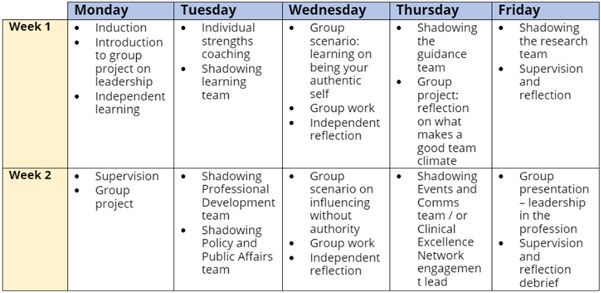
The following is a example outline of what the programme could look like. RCSLT reserves the right to make adjustments to this based on capacity or circumstances.
How to apply
To apply, please fill out the online application form.
Applications open on 27 November 2025 and close on 2 January 2025. Successful applicants will be notified of the outcome of their application during the first two weeks of January 2026. The programme starts on 3 February 2026.
The applications will be reviewed by RCSLT staff. They reserve the right to speak to applicants’ universities before offering the placement.
EDI monitoring:
The RCSLT is committed to a more diverse, inclusive and representative profession. This includes not discriminating under the Equality Act 2010, and building an accurate picture of the make-up of the workforce in encouraging equality and diversity. To help us please complete our EDI monitoring form.
Please note that filling in this form is voluntary. The information provided will be kept confidential and will be used for monitoring purposes.
Mapping of the placement against capabilities and standards
The leadership placement covers the following HCPC standards of proficiency:
1 practise safely and effectively within their scope of practice
1.1 identify the limits of their practice and when to seek advice or refer to another professional or service
2 practise within the legal and ethical boundaries of their profession
2.1 maintain high standards of personal and professional conduct
2.2 promote and protect the service user’s interests at all times
3 look after their health and wellbeing, seeking appropriate support where necessary
3.1 identify anxiety and stress in themselves and recognise the potential impact on their practice
- practise as an autonomous professional, exercising their own professional judgement
4.1 recognise that they are personally responsible for and must be able to justify their decisions and actions
4.2 use their skills, knowledge and experience, and the information available to them, to make informed decisions and / or take action where necessary
4.6 demonstrate a logical and systematic approach to problem solving
4.7 use research, reasoning and problem-solving skills when determining appropriate actions
4.8 understand the need for active participation in training, supervision and mentoring in supporting high standards of practice, and personal and professional conduct, and the importance of demonstrating this in practice
5 recognise the impact of culture, equality and diversity on practice and practise in a non-discriminatory and inclusive manner
5.1 respond appropriately to the needs of all different groups and individuals in practice, recognising this can be affected by difference of any kind including, but not limited to, protected characteristics1, intersectional experiences and cultural differences
5.2 understand equality legislation and apply it to their practice
5.3 recognise the potential impact of their own values, beliefs and personal biases (which may be unconscious) on practice and take personal action to ensure all service users and carers are treated appropriately with respect and dignity
7 communicate effectively
7.1 use effective and appropriate verbal and non-verbal skills to communicate with service users, carers, colleagues and others
8 work appropriately with others
8.1 work in partnership with service users, carers, colleagues and others
8.6 understand the qualities, behaviours and benefits of leadership
8.7 recognise that leadership is a skill all professionals can demonstrate
8.8 identify their own leadership qualities, behaviours and approaches, taking into account the importance of equality, diversity and inclusion
8.9 demonstrate leadership behaviours appropriate to their practice
10 reflect on and review practice
10.1 understand the value of reflective practice and the need to record the outcome of such reflection to support continuous improvement


