


Published
4 February 2026
Author
 Hannah Amos
Advanced Practice in Healthcare programme director, Hannah Amos, explains why Cardiff Met university redesigned its MSc Advanced Practice (Speech and Language Therapy) course to create a more flexible study approach.
The MSc Advanced Practice (Speech and Language Therapy) has been running for many years at Cardiff Metropolitan University, providing opportunities for registered SLTs to return to study and further develop their practice. The programme is aligned with the four pillars of advanced practice: clinical practice, leadership and management, education, and research.

Barriers to study
We knew that the course provided excellent opportunities for learners and had a positive impact on services and patients, but we could also see that access to study could be difficult. The challenges of gaining funding and studying while managing other commitments were impacting our learners. They frequently needed to take time out and found it difficult to balance competing needs. We realised that we needed to take a different approach.
A flexible new course design
Following consultation with learners, NHS colleagues and fellow higher education colleagues, we launched a redesigned Advanced Practice and Microcredentials course in September 2024. Our aim was to provide flexible learning routes in a supportive environment, built around the learner needs rather than a traditional academic structure. This led us to two main developments:
- Creation of our microcredential route to study alongside the traditional part-time route.
- Development of wider range of accessible of modules for SLTs, creating subject-specific opportunities. These included assessing cleft palate and building core skills in interprofessional learning groups such as evidence based practice.
Microcredentials are small units of study which can be stacked up into qualifications over time. We knew that learners would often only get funding for single modules, or feel unsure about committing to a full masters, so we made a route that would allow them to start level 7 study without the pressure of full commitment or funding.
“I learned so much from this topic and from the other students too. It gave me a chance to put all the associating factors together for such a complex case and to reflect on a wide range of factors in depth that I have never considered before.” – Student feedback
On the Microcredential route the learner can choose 1, 2 or 3 modules per year, and may have interim years without academic study as needed. The credits for study are banked by us, and we will consider transfer of other credits from different universities. You can take up to eight years to complete a full masters, and most importantly, the learner only needs to commit to an award (PGCert, PGDip, MSc) when they are ready to.
The SLT pathway now has fourteen different modules which are taught either online, hybrid or via blocked face to face teaching. SLTs study core modules of Evidence Based Practice, Applied Research Methods and Design and Decision Making in Practice alongside other health and care professionals, where they apply learning to their area of specialism while learning from other professions.
Returning to study
Returning to study is different and needs to be treated as such. Our learners are already doing excellent clinical work, are proactive and patient centred. However, outside the course they have high workloads and are often caring for dependents and managing their own health needs,meaning it can be hard to find the time for their own study and progression. In my view these are absolutely the people who we need to invest in. We should support their continued journey in healthcare, teach them new ways of learning and accessing the evidence base, and help them take the opportunities in their work.
“I cannot explain how much it has grown my knowledge but mostly my confidence” – Student feedback
Postgraduate study allows you to feel valued in your knowledge and skills, to take time to consider different perspectives, learn from others, build different networks and make positive change in your working environment. It also gives the confidence to say ‘yes’ to opportunities, and many of our learners present their work in conferences across the UK, as well as disseminating to local teams and networks.
My job is a privilege. I get to work with and hear from a wide range of professionals across the UK and internationally. The reach and the impact is incredible, and changes practice on a daily basis. I always say that I hope learners see an impact on themselves and their clinical practice from day one of study, not just at the end of the course.
View more information on the Advanced Practice in Healthcare Master’s degree.
-
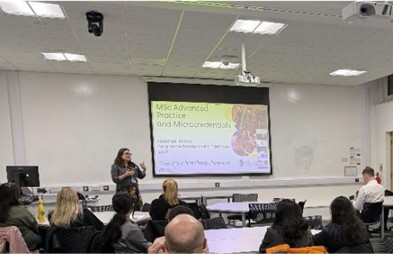
Hybrid Annual Advanced Practice Showcase Evening- building community of practice for past, present and future learners. -
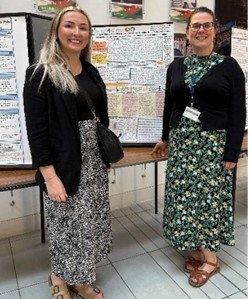
Past student Ellie Jenkins presenting her work on workforce diversification in Neurodevelopmental Assessment -
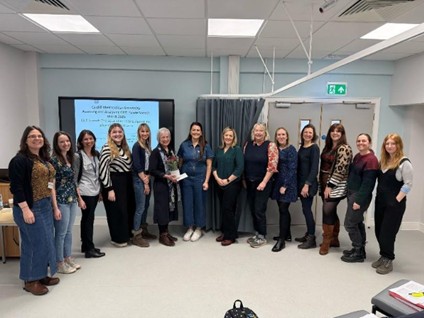
Inaugural cleft palate module run by Lisa Farqhhar, with guest speaker Anne Harding-Bell.
Share this article:


