


Interpreters guidance
This page contains information on interpreters and the role of the speech and language therapist.
Last updated: September 2026
Back to Delivering quality services

 Download as PDF
- Purpose and scope
- HCPC and legal requirements
- Asking school staff, healthcare workers and support staff to act as interpreters
- The role of family members
- Identify the threshold for working with an interpreter
- Mode of interpreting (in-person, video and telephone)
- Choosing an interpreter
- Process for working with an interpreter
- Written translations
- Accessing interpreter services in your setting
- Approaches to supporting access in independent practice
- Business case and advocacy
- Resources and further reading
- Reflection question
- Contributors
Purpose and scope
Speech and language therapists (SLTs) must provide equitable services to all service users, including those who speak languages other than English (LOTE). As the UK is a multicultural society, it is likely that speech and language therapists (SLTs) will work with families with whom they do not share a language. Even if an SLT is bilingual, the large number of languages spoken in the UK means that they are still likely to need to work alongside interpreters.
This guidance outlines best practice for working with professional interpreters in speech and language therapy services and aligns with professional standards and legal obligations under the Equality Act 2010.
Differences in language development related to exposure to more than one language should not be mistaken for a communication impairment. When working with individuals and families who use more than one language, SLTs should consider the individual’s communication abilities across all the languages they use, and ensure that assessment, advice and intervention take account of the person’s full linguistic context.
Speech and language therapists should work collaboratively with professional interpreters and provide interventions in both the home and additional languages, as required. The RCSLT website provides more detailed guidance about bilingualism.
English is the majority language in the UK, particularly in England, and is also the language of education for most children (ONS, 2022). However, many children speak a language other than English (LOTE) at home and in the community. In Wales, the situation is different. Welsh may be a person’s mother tongue (home language) and/or the language of education. The core principle of offering home language support to prevent home language attrition is discussed in the RCSLT bilingualism guidance. Supporting a child’s home language to prevent language attrition does not preclude them from developing bilingualism, including Welsh as an Additional Language (WAL). Where English is discussed below, the same or similar advice applies to Welsh in a Welsh-speaking context. Similarly, in some communities in Scotland, Scottish Gaelic may take this role, or in Northern Ireland, Irish.
Speech and language therapists have no role in teaching English as an Additional Language (EAL) or Welsh as an Additional Language (WAL). The teaching of the language of education is the responsibility of schoolteachers. At all ages, children spend more time at home than at school, and supporting the child or young person’s home language(s) or mother tongue is a key aim when supporting clients to achieve confident bilingualism (Pert, 2022; RCSLT, 2018).
Children and young people who receive assessment and therapy only in English (or Welsh) risk:
- misdiagnosis of typical language differences as language difficulty, developmental language disorder or speech sound disorder
- rapid loss of their home language or mother tongue, and isolation from a parent, family member, extended family and their community.
Many bilingual and multilingual adults will also benefit from support in their home language, either because it is their main means of communication with their spouse, partner, family and community, or because it maintains cultural and linguistic ties with their community and so supports identity and mental wellbeing.
Throughout this guidance, working with or alongside interpreters are phrases used to describe partnership working with professionals who speak LOTE. This is to recognise the value, experience, cultural knowledge and richness of linguistic experience that interpreters provide.
Key recommendations
- School staff should not be asked to act as interpreters in speech and language therapy contexts.
- Family members should not be asked to act as interpreters except in emergency situations.
- Speech and language therapists should carry out assessments in the service user’s home language.
- This will ensure that SLTs are not inadvertently teaching English as an additional language to typical home language/mother tongue speakers.
- Language difficulties, developmental language disorder, language disorder associated with a biomedical condition, and speech sound disorder will be evident in both or all the languages a child speaks.
- SLTs should ensure that they have informed consent from service users and their families regarding working with an interpreter. Where a language barrier exists, informed consent means ensuring that the service user and their family have the risks of working only in English explained to them with the assistance of an interpreter.
- Sessions with interpreters should be planned in advance and followed by a debrief after each session. If a report is required, the role of the interpreter should be clearly documented and detailed within the report.
HCPC requirements
Speech and language therapists should make every effort to work with appropriate interpretation services when needed. In cases where it is not possible to find an interpreter, the Health and Care Professions Council (HCPC) have stated that:
‘Lack of appropriate interpreters should not be a barrier to service access. Where an interpreter is not available, registrants need to evidence their approach to working alongside interpreters in consultation with service users to meet the standards. Any fitness to practise referral regarding the provision of an interpreter would be considered on its own merits and taking into account the particular context.’
In September 2023, HCPC updated its standards of proficiency for all registered professionals, reinforcing the importance of inclusive communication practices. The revised standards place a stronger emphasis on working with interpreters, where required, and ensuring that SLTs adapt their approach to meet the needs of diverse linguistic communities. These updates align with the broader goal of enhancing accessibility and reducing health inequalities across speech and language therapy services. SLTs should use clinical reasoning to determine the use and extent of interpreter involvement and clearly record the rationale for each case. This includes considerations around context, risk and proportionality, particularly for independent practitioners.
HCPC sets out clear expectations for SLTs working with interpreters, including:
- Standard 6.4: understand the need to ensure that confidentiality is maintained in all situations in which service users rely on additional communication support (such as interpreters or translators).
- Standard 7.6: understand the need to support the communication needs of service users and carers, such as through the use of an appropriate interpreter.
- Standard 13.20: assess and plan interventions in the service user’s home language with the assistance of professional interpreters, and with reference to professional clinical guidelines and evidence-based practice.
Legal requirements
Speech and language therapy services have a legal, professional and ethical duty to ensure equitable access to assessment and intervention for all individuals. The Equality Act 2010 and, in relation to children, the United Nations Convention on the Rights of the Child provide important legal and rights-based frameworks for preventing discrimination and reducing barriers to services. Although language is not a protected characteristic under the Equality Act 2010, language and/or communication-related barriers may give rise to unlawful direct or indirect discrimination where they are associated with protected characteristics, such as race or disability. For individuals and families who do not share a common language with the speech and language therapist, working with a professional interpreter is essential to ensure informed consent, meaningful participation in clinical interactions, and accurate assessment. Access to professional interpreting support should therefore be considered a core component of equitable service delivery. Financial or organisational constraints should not prevent services from meeting these legal and ethical obligations.
Key considerations
- Interpreters play an essential role in ensuring equitable access to speech and language therapy services for individuals whose home language differs from English (or Welsh). Where appropriate, this includes the use of signed languages within deaf communities.
- Professional interpreters will have an understanding of the social and cultural contexts of the service user’s community and recognise the complex relationship between language, cognition, emotion and expression within that context.
- Children, family members and untrained individuals should not act as interpreters due to ethical and confidentiality concerns.
- When appropriate, family members and support staff, such as classroom assistants, care staff or hospital staff who speak a language other than English (LOTE), may use their LOTE language skills to support the client under the advice and supervision of the SLT. In this role, they do not provide real-time interpretation but instead help to facilitate understanding by supporting the service user’s communication, reinforcing key messages, or using their shared home language to aid clarity. Their involvement should complement, not replace, collaboration with trained professional interpreters.
- SLTs must plan the use of interpreter involvement carefully, including pre-session briefings and post-session debriefs.
Asking school staff, healthcare workers and support staff to act as interpreters
In line with best practice and professional standards, school staff, including teaching assistants, speech and language therapy assistants, healthcare workers and other support staff, should not be asked to act as interpreters in speech and language therapy contexts. This is due to significant concerns regarding confidentiality, impartiality, and the risk of inaccurate translation.
Classroom assistants, healthcare workers and support staff may use their LOTE skills in specific and appropriate circumstances, such as reminding clients of advice or delivering a therapy programme supervised by the SLT. This role is distinct from that of a professional interpreter and does not involve real-time language interpretation. Instead, they may support understanding by reinforcing key messages or using shared language knowledge to aid communication. However, the primary responsibility for language interpretation remains with a trained professional interpreter. The RCSLT bilingualism guidance reinforces this by advocating for consistent collaboration with qualified interpreters throughout all stages of service delivery.
Asking untrained people, or working with ad-hoc interpreters, including school staff, healthcare workers or other support staff, undermines equitable access, is likely to lead to miscommunication or safeguarding risks, is against professional guidance and HCPC standards of proficiency, and is potentially challengeable under the Equality Act 2010. Services must therefore prioritise working with qualified interpreters who have healthcare experience, and avoid relying on educational, healthcare or support staff for interpreting roles.
School staff, healthcare workers, support workers and family members can play a valuable role in supporting intervention and implementing recommendations in the home language, where appropriate and agreed by the SLT and the service user and/or their family. Their involvement can help reinforce key strategies, promote language development in meaningful contexts, and ensure that intervention is embedded within the service user’s daily environments. This support may include modelling communication strategies, practising target vocabulary, or encouraging interaction in the home language during everyday routines.
This role is distinct from involvement in assessment, diagnostic sessions, or care planning and goal-setting discussions, which must involve professional interpreters to ensure accuracy, impartiality, and adherence to professional standards. The use of school staff, healthcare workers, support staff or family members to support intervention should always be guided and overseen by the SLT to ensure that approaches are consistent, culturally and linguistically appropriate, and aligned with agreed intervention goals. Clear guidance and ongoing communication are essential to maintain the quality and integrity of the therapeutic process.
In exceptional cases, a trained bilingual member of staff may support communication if:
- no professional interpreter is available (this does not include situations where lack of funding or organisational barriers exist)
- the SLT has obtained informed consent
- the bilingual staff member has received basic interpreter guidance, covering the role and boundaries of interpreting, accurate and impartial translation, and confidentiality, and a confidentiality agreement is in place.
All such decisions must be recorded and risk assessed.
For further detailed recommendations, the RCSLT bilingualism guidance provides comprehensive information on working with bilingual service users and ensuring their needs are met effectively.
The role of family members
Due to concerns around confidentiality, impartiality, and the potential for inaccurate or incomplete translation, family members, including children, should not act as interpreters in speech and language therapy sessions, except in emergency situations where no alternative is available. Asking or allowing family members to act as interpreters can result in inaccuracies, breaches of confidentiality, and potential safeguarding concerns. It may also place an inappropriate emotional or communicative burden on the individual asked to interpret, particularly where children are involved. Professional interpreters provide impartial and confidential support and should therefore be used. In some smaller communities, interpreters may know the service user and/or their family as part of their wider community and this needs to be considered when sourcing an interpreter.
During planning and intervention, family members may contribute as cultural informants and experts by experience, supporting understanding and cultural relevance. However, their involvement should not replace working with a professional interpreter when it comes to assessment, diagnostic or safeguarding discussions.
It is important that informed service user choice is respected. There may be instances where a service user or their family expresses a preference not to work with a professional interpreter. In these situations, it is essential that the SLT explores the reasons for this, provides clear information about the interpreter’s role, explains any implications, and discusses any concerns or misconceptions. For example, parents may decline an interpreter if they feel that their English skills are sufficient to answer questions during a parental interview (case history), but an interpreter would still be required for the assessment of the child or young person’s speech and/or language skills to arrive at a differential diagnosis. Many families consider English to be essential for educational success and so reject their home language(s) in favour of English. Reassure parents that a home language approach provides a better language model and will likely lead to successful bilingualism and English acquisition.
If the service user continues to decline interpreter support, the SLT must document the discussion and rationale carefully, including information about informed consent and risk management steps.
Importantly, even if a service user or family chooses not to work with an interpreter for their own communication, the SLT must still arrange for a professional interpreter to be present for the purpose of clinical assessment. This is necessary to ensure the accuracy and integrity of the assessment process, support clinical decision making, and meet professional and legal obligations for equitable service delivery.
Family members may have valuable cultural and linguistic insights and should be involved in discussions about language use, intervention planning and goal setting. However, their role should be as collaborators and advocates, not interpreters. This distinction helps maintain professional standards, protect confidentiality, and ensure that both the service user and the SLT have accurate and impartial language support.
Identify the threshold for working with an interpreter
- Consider the service user’s preferred language for communication as well as preferred method of communication, recognising that this may not be their first language, and determine whether the session can be conducted effectively without interpretation support.
- Remember that children and young people will try to comply with the perceived language situation (pragmatic language selection). Assessments in nursery or school will likely result in English responses, as this is the language expected in that setting.
- Similarly, if the person who is perceived to be leading the session or interaction is identified as a monolingual English speaker – often, though not always, the SLT – the child may be more likely to respond only in English.
- Every effort should be made to provide a safe space where the home language/mother tongue responses are as acceptable as English before assigning language preference or ‘dominance’.
- Assess the purpose and complexity of the session – for example, diagnostic assessment, goal setting, or care planning will typically require a professional interpreter to ensure accuracy and impartiality. However, if the service user and/or their family are comfortable communicating in English (or another shared language) and no new diagnostic information, goal setting or complex discussion is taking place, an interpreter may not be required for things such as booking appointments or brief follow-up sessions to review progress, as in those situations the focus is on reinforcing existing recommendations rather than introducing new clinical information.
- Evaluate the linguistic and cultural demands of the interaction, including any specialist terminology, nuanced communication, or safeguarding discussions that may need skilled interpretation.
- Consider the service user’s communication abilities and the role of family or support networks, ensuring that the interpreter’s involvement is planned where needed and reliance on untrained individuals is avoided.
- Refer to legal, professional and organisational requirements (e.g. the Equality Act 2010, HCPC standards) to ensure that equitable access to services is provided, and document in the clinical records the rationale for decisions regarding interpreter use.
- Consider the nature of the interpreting service required and the rationale behind that decision. Record this decision making and rationale clearly in the clinical records.
Mode of interpreting (in-person, video and telephone)
When arranging support, speech and language therapists need to think about how the interpreting will take place. This may be face-to-face, via video link or telephone.
Although remote interpreting may be appropriate for some appointments, in-person interpreting should be the default mode of interpreting when:
- complex assessments are being undertaken
- visual communication supports or augmentative and alternative communication (AAC) are used
- safeguarding concerns are present
- the work involves young children or individuals with neurodevelopmental differences
- nuanced communication or rapport building is required.
Decisions about whether interpretation is provided in person, by telephone or by video should be guided by best practice and the needs of the service user. When determining the most appropriate method, speech and language therapists should exercise clinical judgement and document this decision making clearly. The chosen approach should enable effective communication, participation, understanding and safety. Cost should not be the determining factor when deciding which mode of interpretation is most appropriate.
Choosing an interpreter
- Speech and language therapists should work with trained professional interpreters who hold recognised interpreting qualifications or professional registration. Professional interpreters are trained to provide accurate, impartial interpretation while maintaining confidentiality and professional boundaries.
- Where specialist knowledge is required, such as in healthcare or education settings, interpreters with relevant sector experience should be prioritised.
- Consider the threshold decision regarding working with an interpreter alongside clinical risk decision making.
- Work in line with any local policies regarding working with interpreters (unless these contravene RCSLT clinical guidance or HCPC standards of proficiency).
- Work alongside professional interpreters with training in medical and healthcare settings.
- Interpreter support must not be via online/text translation services (eg Google Translate).
- Automated translation or artificial intelligence (AI) tools should not be used as a substitute for professional interpreters in speech and language therapy practice. AI systems cannot provide cultural mediation, professional accountability, or the nuanced interpretation required in clinical contexts.
- Due to confidentiality and accuracy risks, family members, particularly children or education staff, should not be asked to act as interpreters.
- Consider cultural knowledge when selecting an interpreter.
Selecting assessments
- Obtain informed consent from service users and their families regarding working with an interpreter. Where a language barrier exists, informed consent requires ensuring comprehension. SLTs should use plain language, pictorial aids or supported communication methods to secure support for interpreting.
- Standardised assessments should not be directly translated, as linguistic structures vary across languages and are likely to be biased due to unfamiliar depictions of people, clothing, activities and objects.
- Informal assessments which meet the cultural and linguistic needs of the client are preferable and as valid as a standardised assessment, which is designed and normed on an English monolingual population.
- Review assessment material in relation to ethical and culturally sensitive materials.
- Take care when interpreting the information gathered, particularly in relation to syntax and linguistic structures, due to potential differences of grammar and word structure in the service user’s home language.
- Assessments will not be standardised to include bilingual children; therefore, the use of standardised scores should not be cited or used to inform clinical decision making. This includes age norms (such as the age at which a phonological process is eliminated), percentile ranks or standard scores.
- Dynamic assessment may be used as part of a broader assessment approach.
Process for working with an interpreter
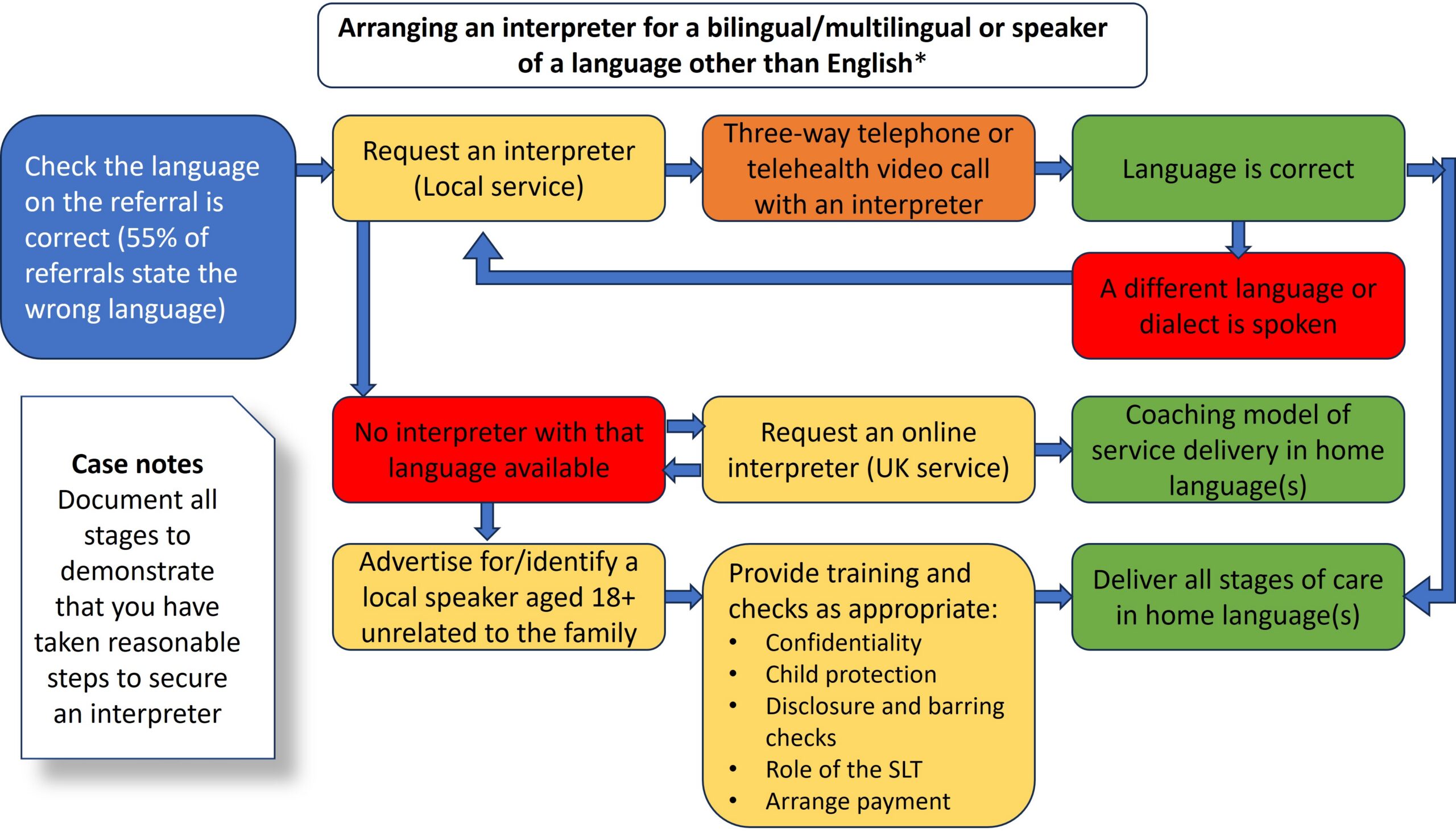
Arranging an appropriate interpreter
- It is important to check that the language(s) of the client and their family match that of the interpreter, as many referrals state the wrong language (Stow, 2006). Many families will report a higher status or more well-known language (for example, ‘Urdu’ rather than ‘Mirpuri’), as their lived experience may indicate that their language is not always recognised.
- Exercise caution as ‘dialects’ are often more dissimilar than those familiar to English monolingual speakers. For example, Mirpuri may be described as a ‘dialect of Urdu’. However, Mirpuri should be treated as a different language requiring a Mirpuri interpreter, as an Urdu interpreter will not be understood.
- Carry out a three-way telephone or video call (service user and family, SLT and interpreter) to check that the interpreter speaks the correct language.
Pre-session planning
- Provide the interpreter with an overview of the purpose of the appointment and the session’s objectives, and discuss expectations of their role during the session.
- Clarify any technical or key terminology, particularly in assessments where direct translation may not be possible.
- Review with the interpreter any assessment sections that may need adjusting to accommodate cultural differences.
- Ask the interpreter to transliterate any target utterances.
- Transliteration is where English graphemes are used to represent the spoken form.
- The interpreter should avoid using the home language script (e.g. Arabic script), which may be correct but will not be able to be read by the SLT after the session.
- For speech assessment, the SLT should use International Phonetic Alphabet script to transcribe any target words modelled by the interpreter.
- Clarify with the interpreter any communication strategies being used.
- Discuss confidentiality and the interpreter’s role as a neutral facilitator.
- Establish a start and end time. Be prepared for the session to take twice as long and consider booking a double appointment to accommodate this. Discuss with the interpreter whether they will need a break during the session.
- Discuss with the interpreter any culturally specific differences that may affect the interaction.
- Explain safeguarding procedures and ensure it is understood that any disclosure made in the home language will need to involve the interpreter in the safeguarding process.
- Discuss with the interpreter the expectation of their role – for example, that they will complete a written record of the service user’s responses as they are said, using transliteration for the home language.
- If the session is taking place via video link, the SLT should arrange beforehand any additional support or training the interpreter may need.
During the session
If the interpreter is providing a face-to-face service, either in person or virtually, the SLT must ensure the following:
- Remain responsible for clinical decision making and ensure that communication remains clear, respectful and accessible.
- Address the service user or family directly, not the interpreter (eg avoid ‘Can you ask…’ statements)
- Use a triangular seating arrangement that allows the service user, SLT and interpreter to see one another’s facial expressions.
- Maintain professional rapport with both the interpreter and the service user.
- Explain to the service user at the start of the session how it is going to run and that as the speech and language therapist you will be running the session. Ensure everyone is introduced and understands their role and the way the session will run.
- Explain to the service user that everything that is said will be interpreted, and check whether that is OK. If they do not consent to this, there must be an agreed procedure guided by local policy.
- Use short simple sentences and clear language.
- Pause frequently to allow space for interpretation and encourage the service user to do so as well.
- Avoid using idioms, jargon or culturally specific references that may be difficult to translate.
- Regularly check the service user’s understanding and provide opportunities for clarification.
- As far as possible, try to ensure that the communication has a ’flow‘, and that the language and pacing used is appropriate to the cognitive level of the service user and their family.
- At the end of the session, check that the service user has understood everything and give them time to ask questions.
- Explain to the service user that the interpreter may occasionally be asked to provide their observations or reflections to help provide a more complete understanding of communication needs.
Preparing for the call
If the interpreter service is via telephone (if it is deemed appropriate or is the only available option):
- Be particularly mindful of safeguarding issues and discussing sensitive content. Discuss with the interpreter expectations regarding safeguarding and recording for safeguarding.
- If concerns arise during the call, have a clear plan for action that is in line with local policy.
- Ensure the interpreter is in a confidential space.
At the start of the call
- Ensure that the interpreter, service user and SLT can hear each other clearly.
- Confirm the audio quality before beginning the session.
- Introduce everyone taking part in the call, including their names and roles.
- Explain that all spoken content will be interpreted and ask for the service user’s consent to proceed on this basis.
- Inform the service user that the interpreter may occasionally be asked to provide their observations or reflections to help provide a more complete understanding of communication needs.
During the call
- Take notes to capture clinical observations and any challenges experienced due to the nature of telephone interpreting.
- Maintain a structured flow to the session, as visual cues are unavailable.
- Speak slowly and clearly, using short, simple sentences.
- Pause frequently to allow interpretation.
- Avoid using jargon, idioms, and culturally specific references that may not directly translate.
- Address the service user directly, not the interpreter (eg say ‘Can you tell me about…’ instead of ‘Can you ask them…’).
- Check the service user’s understanding regularly and provide opportunities for clarification.
- Check that key information has been conveyed accurately.
Post-session debrief
- Discuss the session with the interpreter to share, reflect and identify strengths and challenges encountered during the session.
- Clarify any misunderstandings or miscommunications.
- Clarify any aspects of the translation that may have influenced clinical observations.
- Reflect on any learning points and what could be adjusted in the future, where deemed appropriate.
- Ensure the interpreter is supported, particularly when dealing with sensitive cases.
- For a language sample, use the translation protocol (Pert and Stow, 2003) to directly translate and discuss this process with the interpreter.
- For a speech sample, ensure that you have transcribed both the interpreter’s (adult target) production for comparison with the child or young person’s realisation. If you have parental permission, an audio recording of the child and the interpreter may be helpful for later transcription and checking.
- Use the post-session debrief to ensure that any additional information beyond the specific translation role is captured and shared with the SLT, if it is deemed to be required.
Post-session documentation
- Document that an interpreter was involved in the session and include:
- the interpreter’s full name
- the interpreter’s professional identification number, booking reference and company
- the language and specific dialect interpreted
- the type of interpreting used (in-person, virtual, telephone).
- Summarise the session content, noting key clinical observations and outcomes.
- Record any communication barriers or challenges (delays, misunderstandings, technical issues, etc.).
- Include any relevant cultural insights that influenced the interaction or clinical decision making.
- Highlight any safeguarding concerns raised and how they were managed in collaboration with the interpreter.
- Note whether any adaptations were required due to linguistic or cultural factors.
- Identify follow-up actions, such as arranging further interpreted sessions or seeking cultural consultation.
- Reflect on the impact of the interpreter on the session for your own clinical reasoning and professional development, where required.
- Add an entry to your continuing professional development (CPD) log, if you feel this is appropriate.
For structured guidance, refer to the Working with interpreters checklist (RCSLT, 2026), which outlines key steps for effective collaboration with interpreters.
Written translations
- It is important to understand the distinction between interpreters and translators. Interpreters work with spoken language, facilitating real-time communication between SLTs and service users. Translators work with written language, converting documents from one language to another. SLTs should ensure they are using the appropriate professional service depending on whether written or spoken language support is required.
- Before providing written documents in a service user’s home language, including reports, care plans, advice sheets, clinical information or other written resources, consider whether the service user is literate in their home language and follow appropriate accessibility and literacy guidance. Some languages such as Mirpuri have no written form, while some speakers may not have had opportunities to access sufficient education to acquire literacy skills.
- Where written translation is not effective, offer verbal explanations or multimedia resources. Videos of interpreters explaining commonly encountered conditions such as speech sound disorder can be linked to printed leaflets using a QR code. This increases access to information.
- Where written home language version of a document is produced, retain both the home language and the English language version within the clinical record.
- A written care plan should be provided in the home language, either via written or verbal means to the service user and/or their families, and state the language in which the intervention will be delivered, as deemed appropriate by the SLT.
- When providing written translations, ensure that materials are accessible, culturally appropriate, and convey clinical information accurately.
- For non-confidential general advice leaflets, a video and/or audio version should be produced where possible and uploaded to the NHS trust/Board or to the website of the company providing the speech and language therapy services. This should be linked to the written resource by printing a QR code with a hyperlink to the uploaded video or audio file.
- Co-producing these resources with the communities they serve will ensure that resources are meaningful and acceptable.
- If translated written documents are provided, families and service users should have the opportunity to review the content with a professional interpreter to ensure accurate understanding. During this, they may also wish to make notes or record explanations (with consent) to support later review.
- For reports and any other confidential information that is provided, encourage the family to record the session to their own smart device. They can then review the spoken home language explanation of the report and any questions.
Accessing interpreter services in your setting
Accessing interpreters varies depending on the setting. In the NHS, interpreter services are usually commissioned centrally and accessed via internal booking systems, often including face-to-face, telephone and video options. Translation services for written materials are also usually available through these systems to support the provision of accessible information in the service user’s preferred language. Speech and language therapists should familiarise themselves with local protocols for booking and funding both interpreter and translation services, and ensure adequate time is planned for sessions and document preparation requiring language support.
In school-based services, access may be more limited and depend on the local authority’s arrangements or the school’s budget. SLTs in educational settings should advocate for both interpreter and translation support as part of inclusive practice and to align with statutory duties under the Equality Act 2010.
It is important to educate school leadership teams on the role of the SLT. Speech and language therapists do not teach English as an additional language. Therefore, not being able to speak English at the same level as monolingual children of the same age is not a justification for referral to speech and language therapy services. Children with language difficulties, developmental language disorder, or language disorder associated with a biomedical condition will have difficulties present in both or all of their languages. Typical EAL children will have no problems acquiring their home language or mother tongue. There is no circumstance where a speech and language disorder can only occur in the additional language. Only home language assessment can differentiate between typical additional language learners and those with a speech and/or language disorder, especially in the early years. The situation is the same for speech sound disorders. Both or all languages will have evidence of speech errors.
Read ‘Advocating for access to professional interpreters’.
In independent practice, responsibility for arranging and funding interpreter and translation services will vary depending on the practitioner’s context, including whether they are a sole trader, part of a larger organisation, or working under a commissioning arrangement. Regardless of the model of practice, speech and language therapy practitioners are responsible for ensuring that communication needs are appropriately supported in line with professional, ethical and legal duties, including standards set by the Health and Care Professions Council and the Equality Act 2010.
In some independent practice contexts, particularly in areas of high linguistic diversity, a substantial proportion of the caseload may require interpreter support. In these situations, transferring interpreter costs directly to families can create financial barriers and limit access to services, particularly for those already experiencing socioeconomic disadvantage. This should be recognised as a system level and commissioning issue, rather than solely the responsibility of the individual practitioner.
Approaches to supporting access in independent practice
To enable equitable access, independent practitioners should consider a range of approaches while maintaining the viability of their service:
- Shared funding and commissioning
Where services are commissioned (e.g. by schools, local authorities or health providers), interpreter provision should be discussed as part of the commissioning agreement. Costs may be shared or covered by the commissioning body, particularly where input relates to education, safeguarding, or statutory responsibilities. - Partnership working
Practitioners may explore collaborative arrangements with schools, early years settings, local authorities or community organisations to jointly fund or access interpreter services. - Use of remote interpreting
Telephone or video interpreting may offer a more cost-effective and flexible option, particularly if local provision is limited. However, decisions regarding interpreter access should be led by the need of the service user and not financial or organisational constraints. - Service level planning
In areas of high need, practitioners should consider how interpreter provision is built into service delivery models. - External and charitable support
In some cases, families or practitioners may be able to access support through local charities, community organisations or advocacy groups. For example:- Citizens Advice may support families in understanding their rights and accessing services
- Refugee Council and Migrant Help may provide or signpost to language support for specific populations.
Availability will vary locally and these options should not replace the provision of appropriate clinical support, where required.
Business case and advocacy
If interpreter provision is not funded or accessible, SLTs may need to advocate for support. This could include developing a business case to demonstrate the clinical, legal and ethical necessity of providing interpreter services.
A business case may be directed to:
- commissioning bodies (e.g. schools, local authorities, NHS services)
- organisational leadership (in larger independent practices)
- collaborative networks or funding partners.
The business case should clearly outline the:
- risks of not providing interpreter support (e.g. misdiagnosis, reduced engagement, inequitable access, safeguarding concerns)
- impact on equitable access and compliance with legal duties
- implications for clinical outcomes and long-term costs.
This process reframes interpreter provision as central to safe and effective care, rather than an optional additional cost.
If no interpreter is available, the SLT must document the efforts made to secure appropriate support and record any discussions with the service user or their family about the associated risks and possible alternatives. Trained bilingual advocates may be used only where informed consent has been obtained and the decision is deemed clinically appropriate. In such cases, the SLT should clearly record in the clinical notes their reasoning and risk management actions to demonstrate compliance with HCPC standards and maintain transparent, defensible practice.
Resources and further reading
- UK Government: Equality Act 2010
- RCSLT bilingualism guidance – essential reference for SLTs working with bilingual people
- Office for National Statistics (2022). Language, England and Wales: Census 2021. Main language, English language proficiency, and household language in England and Wales, Census 2021 data.
- Pert, S. (2022). Working with Children Experiencing Speech and Language Disorders in a Bilingual Context: A Home Language Approach. London: Routledge. https://doi.org/10.4324/9781003125563
- Pert, S. and Stow, C. (2003). A Translation Protocol for Speech and Language Therapists. 5th CPLOL Conference, Edinburgh.
- RCSLT Working with interpreters checklist (2026) (PDF) – a step-by-step guide for best practice
- RCSLT Working with Interpreters Standards Update (2024) (PDF) – new standards for speech and language therapists working with children and young people in their home language
- Stow, C. (2006). The identification of speech disorders in Pakistani heritage children. Unpublished doctoral thesis. University of Newcastle upon Tyne. http://theses.ncl.ac.uk/jspui/handle/10443/1588
- RCSLT Advocating for Access to Professional Interpreters
- NHS Blackburn with Darwen Care Trust plus the Community Volunteer Interpreter Project (2010). Good Practice Case Study.
- The London Bilingualism CEN has also developed guidelines for Working with interpreters via video-conferencing software to deliver telehealth (2020) (PDF).
UK regional languages
- The Welsh Language Act (1993) and Welsh Language (Wales) Measure 2011: for SLTs working with Welsh speakers. These acts gave Welsh official status in Wales.
- Gaelic Language (Scotland) Act 2005: this Act established Bòrd na Gàidhlig to promote and safeguard Gaelic in Scotland, required certain public bodies to prepare Gaelic language plans, and aimed to provide Gaelic ‘equal respect’ with English in Scotland.
- Scottish Languages Bill (2025): this legislation gives both Gaelic and Scots languages official status in Scotland, and aims to bolster their support, including in education.
- Identity and Language (Northern Ireland) Act 2022: this UK-parliament Act gives the Irish language official recognition in Northern Ireland and acknowledges Ulster Scots/Ulster British tradition as a minority tradition (with associated provisions such as appointing an Irish Language Commissioner and prescribing standards for public authorities).
There are no specific Acts covering other UK community or heritage languages (e.g. Cornish, British Sign Language, Romani) to the same degree, but there are policy frameworks and recognitions, including:
- British Sign Language (BSL) Act 2022: gives BSL legal recognition as a language of England, Wales and Scotland, and places a duty on UK Government departments to promote and facilitate its use.
- Cornish was recognised by the UK Government under the European Charter for Regional or Minority Languages (ECRML) in 2002, but there is no specific UK or English legislation giving Cornish legal status.
- Romani and Yiddish are also recognised under the ECRML as non-territorial minority languages in the UK, with commitments to promote and protect them, but again no specific Acts.
Reflection question
Consider the following question while reviewing the guidance: How can speech and language therapists ensure that they work effectively with interpreters to provide equitable and culturally competent care, while also addressing potential challenges such as linguistic nuances, ethical considerations and resource limitations?
Contributors
This guidance has been developed with contributions from representatives from HCPC, ASLTIP and other expert stakeholders.
Lead authors
- Paula Walker, Highly Specialist Speech and Language Therapist
- Nicola Holmes, Chair of ASLTIP
- Dr Sean Pert, Senior Clinical Lecturer
- Sunita Shah, Highly Specialised Speech and Language Therapist (bilingualism), RCSLT advisor
Supporting authors
- Jo Bradburn, Deputy Director of Allied Health Professions and Speech and Language Therapist
- Natacha Capener, Lecturer and Speech and Language Therapist
- Wing yee Lam, Practice Development Speech and Language Therapist
- Maria Luscombe FRCSLT
- James Martin, Highly Specialist Speech and Language Therapist (Head and Neck)
- Katie Masters, Specialist Speech and Language Therapist
- Claire Matheson, Service Lead Adult Learning Disability
- Rosalind Gray Rogers, Programme Director for Speech and Language Therapy
- Jo Taylor, Speech and Language Therapist


